Journal
Lullanagar & NIBM Road: South Pune’s Space-First Alternative to Camp Living
When central heritage neighbourhoods run out of room, buyers begin prioritising how they live rather than where the address sits For decades, living around the Cantonment and Camp area defined South Pune’s social centre. The tree cover, club culture, and walkable roads created a lifestyle that felt distinct from the rest of the city. Even today, a home near Camp, Pune carries legacy appeal that few neighbourhoods replicate. However, by 2026 the limitation of mature neighbourhoods has become clea
- Published
- Category
- Micro-Market Analysis
- Reading time
- 5 min 5 min read
Contents09
When central heritage neighbourhoods run out of room, buyers begin prioritising how they live rather than where the address sits
For decades, living around the Cantonment and Camp area defined South Pune’s social centre. The tree cover, club culture, and walkable roads created a lifestyle that felt distinct from the rest of the city. Even today, a home near Camp, Pune carries legacy appeal that few neighbourhoods replicate.
However, by 2026 the limitation of mature neighbourhoods has become clear. Space is finite. New supply comes only through small redevelopment plots, and most apartments prioritise the address over the living format. Buyers often find themselves choosing between a central location and the spatial comfort expected from modern luxury housing.
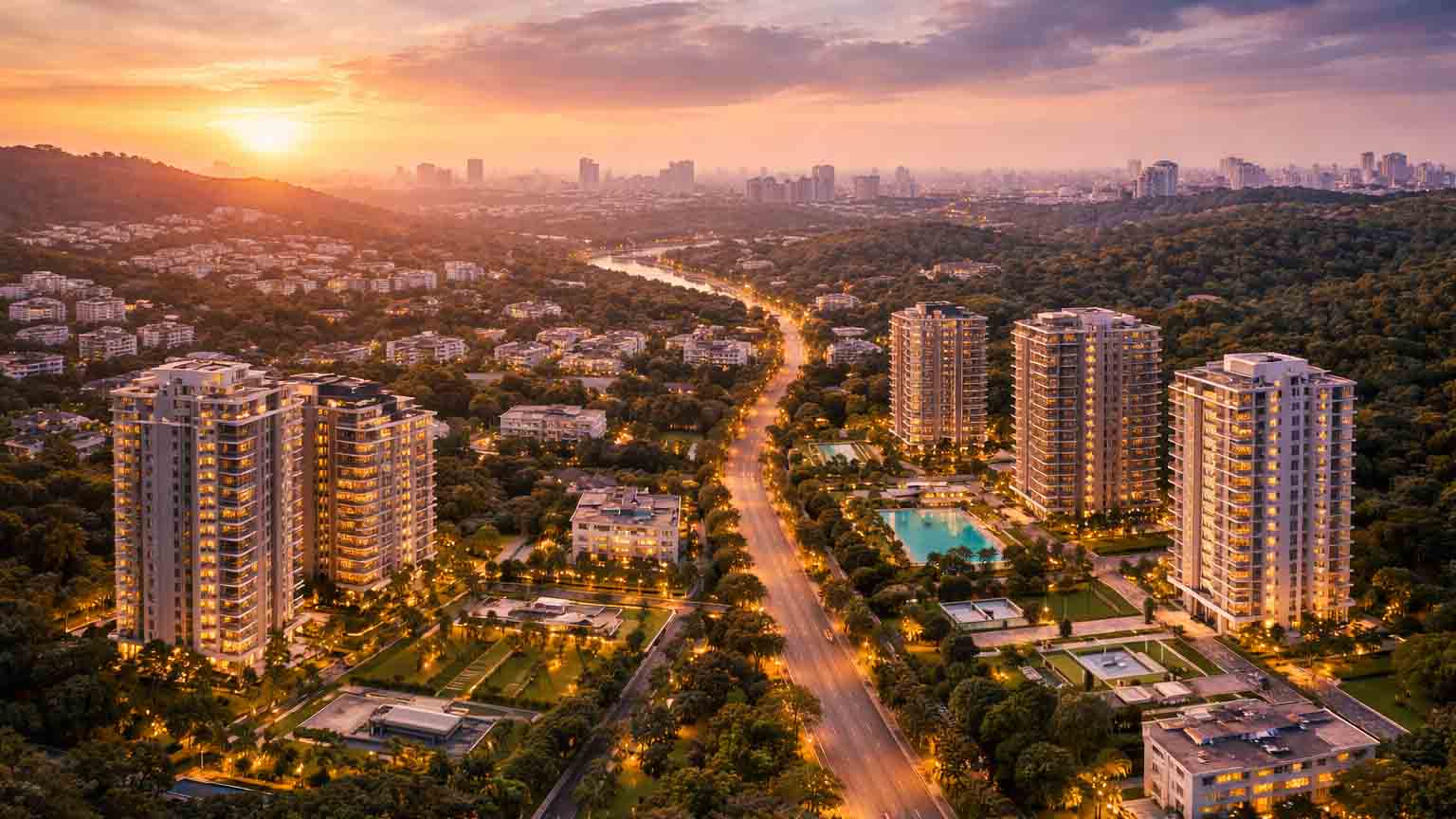
This shift has gradually redirected attention toward the corridor stretching across Lullanagar and NIBM Road, where larger residential layouts and gated environments are structurally possible. The movement is not driven by affordability alone but by the growing gap between legacy living and contemporary living standards.
The Limits of Central Supply
Camp’s real estate behaviour is shaped by its planning history. Buildings tend to be standalone, plots are compact, and redevelopment options remain restricted by surrounding infrastructure. As a result, new projects rarely accommodate expansive internal amenities or low-density planning.
In practical terms, buyers in central South Pune usually obtain a well-located residence but depend on external infrastructure for recreation, walking space, and community activity. This model worked for decades when family structures and daily routines were different. In 2026, many households expect private workspaces, controlled play areas, and predictable security within the project itself.
Neighbourhoods further south evolved later and therefore allow integrated residential planning rather than retrofitting it.
Cosmopolitan Continuity
A good indicator of this shift is how branded developers are entering South Pune with long-term conviction instead of speculative launches. Tribeca Developers, known for design-led luxury residences, has already announced a mixed-use residential project in Lullanagar and is simultaneously developing a high-end residential community off NIBM Road, Similarly, developers such as Nyati Group have introduced projects like Nyati Elenor in the broader corridor, signalling that the micro-market is no longer considered peripheral but structurally premium.
Rather than isolated towers, these projects are increasingly planned as integrated living districts combining residential spaces with curated retail and lifestyle infrastructure. This pattern typically appears only after a location achieves stable end-user demand rather than investor-driven momentum. When multiple established developers begin committing to long-term projects within the same corridor, it often indicates that the neighbourhood is transitioning from being viewed as an “alternative” to becoming a primary residential choice for the city’s next phase of luxury housing.
Why Gated Living Became Important
The appeal of the Lullanagar–NIBM belt comes from parcel size rather than trend. Larger land holdings allow developments to include internal greens, circulation roads, and amenities that do not compete with traffic movement.
Instead of relying on surrounding roads for leisure, residents increasingly prefer contained environments that support everyday routines. This particularly matters for multi-generational households where children, working adults, and senior citizens use the neighbourhood differently at different times of day.
Projects across the corridor illustrate this planning shift, offering layouts designed around internal movement rather than street dependency.
Lullanagar’s Changing Role
Historically seen as a connector between central Pune and Kondhwa, Lullanagar has gradually become a destination rather than a transit point. Newer residential developments have introduced larger configurations and building heights uncommon in traditional Camp housing formats. This changes buyer expectations. Instead of adapting to smaller rooms and older layouts, buyers entering the ₹3–6 crore segment now look for dedicated study areas, staff utility space, and better separation between private and shared zones within the apartment.
The location remains close enough to central South Pune to retain familiarity while allowing a fundamentally different living configuration.
NIBM Road and Social Continuity
A major hesitation among Camp residents considering relocation is the fear of losing their familiar daily ecosystem. Over the past decade, NIBM Road has gradually developed its own commercial and social infrastructure rather than functioning purely as a residential extension of the cantonment area.
Cafes, speciality grocery stores, fitness studios, and international schools now form a self-contained routine environment. Premium residential developments such as Ark Cullinan by Tribeca and newer luxury communities along the NIBM corridor further reinforce this shift by bringing higher-density end-user housing closer to lifestyle infrastructure. The result is that residents no longer need to commute back toward central Pune for everyday experiences.
Importantly, this demand has remained largely end-user driven rather than speculative. When residential demand grows alongside schools, neighbourhood retail, and everyday services, it tends to stabilise long-term occupancy patterns and strengthens the neighbourhood’s position as a livable alternative to the traditional Camp address.
The Value Translation Buyers Notice
In central locations, a large portion of purchase cost reflects land scarcity and historical desirability. In the Lullanagar–NIBM belt, a greater share of cost translates into internal area and planned infrastructure.
As a result, buyers comparing options often evaluate not only the price per square foot but also how much functional living area their budget actually secures. The decision becomes less about comparing neighbourhood prestige and more about comparing daily comfort.
This behavioural shift explains why many long-time South Pune residents now consider relocating within the same zone rather than moving across the city.
Long-Term Behaviour of the Two Markets
Legacy neighbourhoods typically show strong price stability because supply remains constrained. However, they evolve slowly due to limited redevelopment flexibility. Newer but established corridors grow through gradual absorption as families prioritise livability improvements.
Neither pattern is inherently superior. One preserves historic identity while the other adapts to changing household structures. Buyers increasingly choose based on which model aligns with their expected length of stay rather than short-term appreciation assumptions.
The 3 Works Perspective
The movement toward Lullanagar and NIBM Road is less about leaving Camp and more about redefining comfort within South Pune. Families who value walkable heritage surroundings often continue to prefer central locations, while those prioritising internal space and predictable routines tend to migrate toward planned residential pockets.
In most cases the decision becomes clearer after observing daily patterns rather than comparing brochures. Traffic flow, access convenience, and usable interior layout usually determine satisfaction more than the address label itself.
Where This Leaves the Buyer
If you are evaluating homes within South Pune, visiting both central Camp pockets and the Lullanagar–NIBM corridor during different times of the day helps reveal how each location supports everyday routines.
At 3 Works Properties, advisory discussions focus on matching lifestyle patterns with neighbourhood behaviour so the decision remains relevant years after purchase rather than only at the time of transaction.
Updated
Views
37
3 Works Properties
Editorial team · Micro-Market Analysis
Market notes, buying guides, and location stories from 3 Works Properties.
Journal
Related articles
 Micro-Market Analysis4 min read
Kalyani Nagar 2.0: Understanding the Real Value Behind Redevelopment Luxury
As central Pune rebuilds vertically, buyers must distinguish true location value from label-based pricing The evolution of Kalyani Nagar has entered a decisive phase. Independent homes that once defined the neighbourhood are steadily being replaced by mid and high rise residential projects. For many buyers, redevelopment in an established locality appears ideal because it promises modern amenities without sacrificing a proven address. In reality, redevelopment introduces variation. Some projects
Read more Micro-Market Analysis4 min read
Upper Kharadi vs. EON IT Park Radius: Decoding the 2026 Price Gap for Tech Executives
Is the walk-to-work privilege worth the premium, or does a 10-minute drive unlock a better class of living? For senior professionals moving into Pune’s eastern IT corridor, the housing brief sounds straightforward: live as close as possible to EON IT Park or the World Trade Center. For years, this automatically meant central Kharadi within the immediate office radius. In 2026, that logic is changing. The availability of large residential land parcels inside core Kharadi has almost disappeared. M
Read more Micro-Market Analysis4 min read
Sopan Baug vs. Koregaon Park: Choosing Between Pune’s Greenest Luxury Addresses
For decades, Koregaon Park has defined premium living in Pune. Its leafy lanes, international dining culture, and long-standing social reputation created an neighbourhood that symbolised arrival as much as residence. But cities evolve, and in 2026 one of the biggest drivers of buyer decision-making is no longer prestige alone, it is livability under pressure.
Read more
Explore