Journal
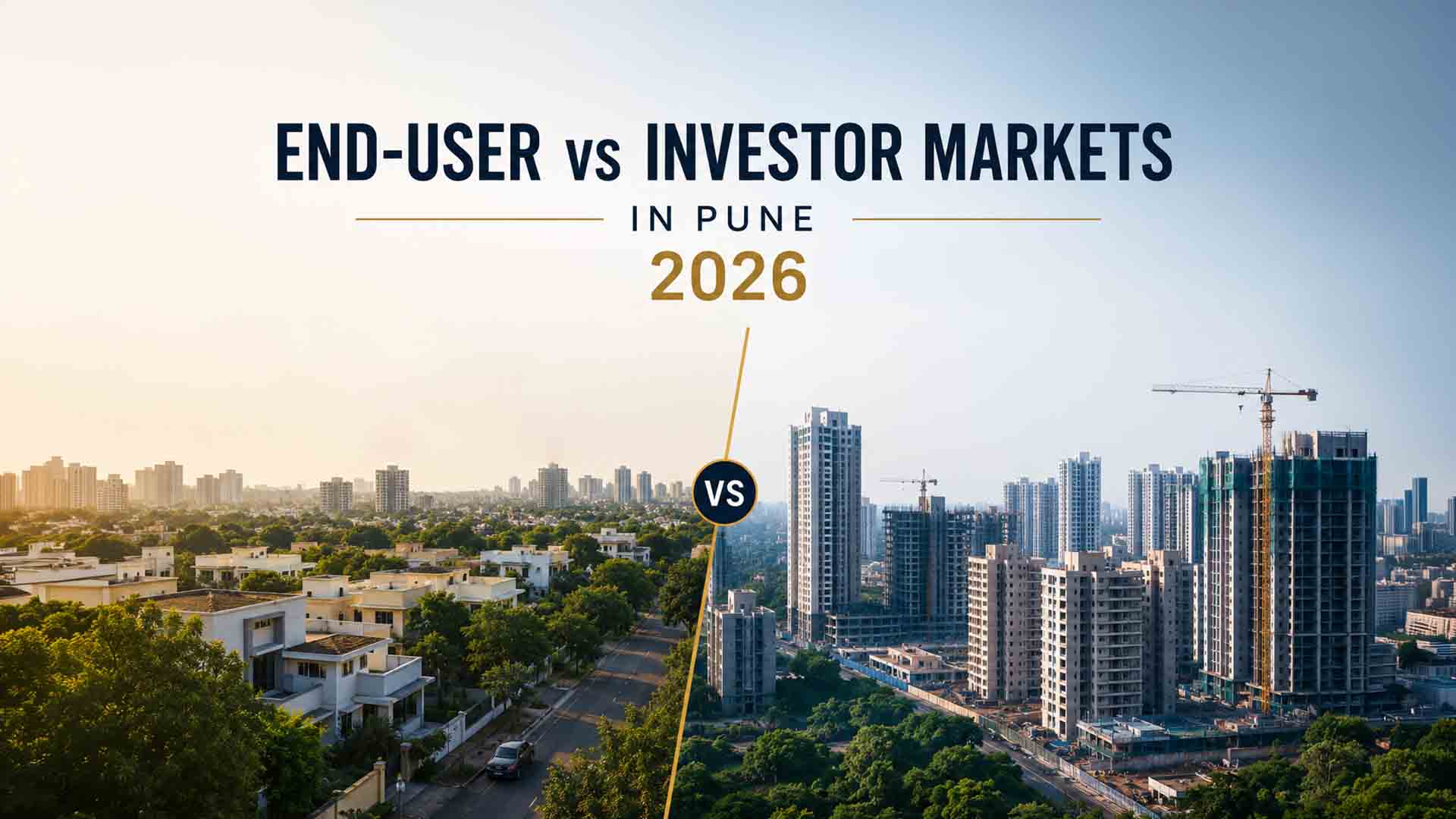
End-User vs Investor Markets in Pune: Understanding the 2026 Divide
Why some micro-markets are driven by real livability demand while others continue to depend on investor momentum For years, Pune’s real estate market moved largely as a single growth story. If infrastructure improved or IT hiring increased, almost every corridor benefited together. That is no longer the case in 2026. Today, Pune’s residential market has clearly split into two categories: End-user driven markets Investor-led markets This distinction matters more than ever because both markets beh
- Published
- Category
- Market Trends
- Reading time
- 5 min 5 min read
Contents13
Why some micro-markets are driven by real livability demand while others continue to depend on investor momentum
For years, Pune’s real estate market moved largely as a single growth story. If infrastructure improved or IT hiring increased, almost every corridor benefited together. That is no longer the case in 2026. Today, Pune’s residential market has clearly split into two categories:
- End-user driven markets
- Investor-led markets
This distinction matters more than ever because both markets behave very differently during slowdowns, infrastructure delays, rental cycles, and inventory corrections.
At 3 Works Properties, one of the biggest mistakes we see buyers make is evaluating all micro-markets using the same investment logic. A strategy that works in Koregaon Park may completely fail in a high-supply corridor on the city edge.
Understanding this divide is now critical for anyone buying in Pune between 2026 and 2030.
What Defines an End-User Market?
An end-user market is driven primarily by people intending to live in the property rather than purely invest in it. These locations usually have:
- Established social infrastructure
- Stable residential demand
- Limited land supply
- Strong lifestyle ecosystem
- Lower speculative inventory
In Pune, areas such as Koregaon Park, Kalyani Nagar, Aundh and parts of NIBM Road increasingly function as end-user dominant markets.
These areas typically appreciate slower during hype cycles but remain more resilient during corrections because demand is tied to actual living requirements rather than short-term speculation.
This pattern is already visible in premium central corridors discussed in Koregaon Park Guide and Kalyani Nagar 2.0
What Defines an Investor-Led Market?
Investor-driven markets behave differently. Demand in these corridors is often fuelled by:
- Future infrastructure expectations
- Lower ticket sizes
- New launch velocity
- Rental optimism
- Perceived affordability
Locations with large land availability and continuous new supply naturally attract more investor participation. Historically, areas such as outer Wagholi, fringe Tathawade belts, and certain peripheral expansion zones have seen stronger investor concentration. This does not mean these markets are weak. In fact, they often outperform during early growth cycles. However, they also tend to experience:
- Higher inventory pressure
- Greater pricing competition
- Longer absorption timelines
- Sharper reactions to economic slowdowns
The key difference is that investors can pause purchases quickly, while end-user demand tends to remain consistent because it is linked to lifestyle needs rather than market timing.
Why 2026 Is a Turning Point
Three major shifts are accelerating this divide:
1. Hybrid Work Has Changed Location Priorities
Between 2018 and 2022, proximity to office campuses dominated buying decisions. In 2026, buyers increasingly prioritise:
- Larger homes
- Lower density environments
- Community infrastructure
- Home-office functionality
This is why areas offering livability rather than just commute advantage are seeing stronger end-user conversion. The changing preference toward larger and more lifestyle-oriented housing is already visible in East Pune’s evolution, explored in Upper Kharadi vs EON IT Park Radius
2. Infrastructure Speculation Has Become More Selective
During earlier cycles, almost any infrastructure announcement triggered broad-based speculation. Today’s buyers are more cautious. The market has become increasingly aware that infrastructure appreciation depends heavily on:
- Execution timelines
- Connectivity integration
- Existing demand fundamentals
This is especially relevant in discussions surrounding Metro corridors and the Pune Ring Road. As analysed in Metro Line Delayed buyers are now distinguishing between announcement-driven excitement and actual operational impact.
3. Supply Is Defining Market Stability
Micro-markets with limited future supply are behaving very differently from high-expansion corridors. For example:
- Koregaon Park has almost no large undeveloped land parcels remaining
- Redevelopment inventory in central Pune enters the market gradually
- Peripheral corridors continue to launch inventory at scale
This creates an important pricing distinction:
- Scarcity markets protect value
- Expansion markets compete on absorption
Neither is inherently better, but they serve different buyer objectives.
The Rental Yield Misconception
Many investors still evaluate markets purely on rental percentages. However, in Pune, the highest rental yield zones are not always the strongest long-term wealth markets. Investor-heavy corridors may generate healthy yields initially due to IT demand, but excessive future supply can suppress appreciation over time.
Meanwhile, premium end-user markets often produce:
- Lower headline yields
- Better capital preservation
- Higher resale liquidity
- Stronger long-term pricing resilience
This is one reason why ultra-prime locations continue attracting capital despite lower yield percentages.
The Rise of “Livability Capital”
One of the clearest 2026 trends is the emergence of what can be called livability capital. Buyers are increasingly paying premiums for:
- Walkability
- Green cover
- Lower traffic friction
- Established neighbourhood identity
- Better schools and social infrastructure
The market is slowly shifting from “maximum inventory” to “maximum usability.”
So Which Market Should a Buyer Choose?
The answer depends entirely on the objective.
End-user dominant markets generally suit:
- Long-term homeowners
- Wealth preservation buyers
- Families prioritising stability
- Buyers seeking resale resilience
Investor-heavy markets generally suit:
- Higher growth tolerance
- Longer holding periods
- Buyers comfortable with volatility
- Early-stage infrastructure investing
The mistake is assuming both should be evaluated identically.
The 3 Works Perspective
Pune is no longer one unified housing market. It is a collection of micro-economies behaving differently based on supply, infrastructure, employment patterns, and lifestyle demand.
Understanding whether a location is driven primarily by end-users or investors is now more important than simply identifying “hot” areas.
The strongest decisions in 2026 are being made by buyers who understand not just where the city is growing, but why demand exists there in the first place.
Where This Leaves the Buyer
Before choosing a location, ask a more important question:
“Would people still want to live here if prices stopped rising for two years?”
That answer usually reveals whether a market is fundamentally strong or purely momentum-driven. At 3 Works Properties, our advisory process focuses on identifying markets supported by real demand, long-term livability, and sustainable absorption rather than short-term hype cycles.
Updated
Views
16
3 Works Properties
Editorial team · Market Trends
Market notes, buying guides, and location stories from 3 Works Properties.
Journal
Related articles
 Market Trends3 min read
The 8 Million Sq. Ft. Signal: Why Pune’s Office Market Quietly Outperformed in 2025
How disciplined demand and quality leasing reshaped commercial real estate momentum While residential real estate in Pune went through a phase of consolidation in 2025, the city’s commercial office market told a very different story. Against the backdrop of global uncertainty and selective corporate expansion, Pune recorded one of its strongest office leasing years in recent cycles , crossing the ~8 million sq. ft. absorption mark. This performance wasn’t driven by speculation—it was driven by s
Read more Market Trends3 min read
The 2025 Pivot: How Pune Real Estate Quietly Shifted from Volume to Value
Why moderation in sales volumes may define smarter residential investments in 2026 If you tracked Pune’s residential real estate headlines in 2025, the signals appeared mixed. Transaction volumes softened compared to the post-pandemic surge, yet prices across several established micro-markets continued to move upward. This wasn’t a contradiction. It was a correction. By the end of 2025, Pune had clearly transitioned from a high-volume, affordability-led market to a selective, value-driven one
Read more
Explore